Tuesday, October 28, 2025

AI for Good in SUNY Korea's Department of Technology and Society DTS: The broader context

 Yesterday (Monday October 27) I had the pleasure of attending the fifth annual DTS faculty panel.This year the topic was AI for Good. It was held in C103, an auditorium-style classroom on the SUNY Korea campus.  As the faculty panel presentations followed by Q&A proceeded I could not help but think of the appropriateness of the venue as it was held a building directly adjacemt to and connected with Oh Myung Hall.  In the spring of 2017 a naming ceremony was held to formally name the B wing of SUNY Korea Oh Myung Hall.   Also that spring Dr. Oh was inducted into the CEAS Alumni Hall of Fame at Stony Brook University.  Read more about these two events here.

 Dr. Oh Myung's many accomplishments in government, higher education and industry, the foundation of the Incheon Global Campus stands out.  It was no accident that SUNY Korea's Department of Technology and Society was the first program to open for student enrollment and most of the other departments that followed were from Stony Brook's College of Engineering and Applied Sciences.

In 2021 Dr. Oh donated his personal library of books and other documents to the Incheon Global Campus library to help establish the "Dr. Myung Oh: Gateway to Korean ICT ."  (more details at this link)  Use Google translate for English version.  And further detail at this link.

As of this month (October 2025) Dr. Oh Myung maintains an active interest in Korea's ICT sector of which he is widely acknowledged to by the godfather.  This very much includes AI, as indicated in a recent interview with The Asia Business Daily.  In the interview, Dr. Oh points the way toward a leadership role for Korea in the AI era, building upon the digital revolution that propelled the nation from developing status to a world leader in networks and digital technologies.  

Tuesday, December 31, 2024

President Jimmy Carter, the 444 day Iran Hostage Crisis and US Television News

 The news of former US president Jimmy Carter's death is what prompts me to write this post.  The Iran hostage crisis began in November of 1979 and stretched on for 444 days, ending only after Jimmy Carter had left the White House in January of 1981.  It was a major factor in his defeat in the 1980 presidential election against Ronald Reagan.

In 1986 my case study titled "Television and U.S. Foreign Policy:  The case of the Iran Hostage Crisis, " was published in the Journal of Communication. In recent years, that study has consistently been cited by some influential scholars of political communication and I've wondered exactly why, so I decided to look into it.   A PDF copy of the article can be found on Google Scholar, along with a bar chart showing annual citations by year and links to each of the citations.  One reason for the scholarly interest is that the article was included as a chapter in Doris Graber's book, Media Power in Politics, 1990.  Seven of the 98 citations were to the chapter in her book.  Other reasons for continued interest in the study are the highly visual character of television news and the nature of its relationship to the foreign policy process in the 1970s and early 1980s.  At that time Walter Cronkite was still anchoring the CBS Evening News and he was known to many as the most trusted man in America.  Instead of concluding his news telecast with "and that's the way it is on this ____st day of November" Cronkite adapted it to ".. and that's the way it is on this ____day of captivity for the American hostages in Tehran..." thus providing a nightly countdown reminding viewers of the duration of the hostage crisis.

Saturday, December 7, 2024

The December 2024 martial law in Korea: more context

 The short lived declaration of martial law in Korea by President Yun earlier this month (December 2024) shocked everyone and resonated strongly with the nation's political history during the latter half of the 20th century.  My own shock was based partly on personal experience.  I taught English at Kangwon National University when Park Chung Hee, was president.   The Fall semester of 1972 was shortened and came to an abrupt end when President Park imposed his Yushin "revitalizing reforms" to strengthen the military control over government.  I still recall the day in October 1972 when I saw the military enter campuses, including a half tracked armored vehicle clanking up the road to enter the Songshim Women's University (now the campus of Hallym University in Chuncheon).

On my return to the U.S. following Peace Corps service, I completed the Ph.D. in communication at Stanford and began a teaching career at the U. of Texas in Austin.  That was where I was located in the Fall of 1979 when President Park Chung Hee was assassinated by the chief of his CIA.  After the assassination general Chun Doo Hwan took power in a staged military coup that culminated in the Kwangju pro-democracy uprising in the Spring of 1980.

During the 1980s, opposition to military government grew and demonstrations by students and activists steadily increased until there was a breakthrough in June of 1987. (the famous June 29 declaration televised address by Roh Tae Woo, who would later be elected President)  As it happened, I had been awarded a senior Fulbright grant to teach and conduct research at Yonsei University in the 1985-86 academic year.  The anti-military government demonstrations at Yonsei University were quite active in the Spring of 1986 and I personally witnessed quite a bit of the violence and smelled a lot of tear gas.

For more of the historical context of martial law in Korea during the latter half of the 20th century, see this Canadian Journal of Communication article that I wrote along with Sogang University Professor Kim Hak Soo.

Sunday, May 26, 2024

The future of generative AI in Korea

 During the past several semesters, including Spring 2004, I've been teaching an undergraduate course entitled Modern Digital Technologies and Innovation (EST 204 at Stonybrook University).  Not surprisingly, the public introduction of generative AI with the release of chatGPT in the Fall of 2022 had a big impact on my approach to this class.  I've been encouraging students to explore the possibilities of generative AI for both good and bad.  The "emergent properties" sometimes generated by AI models may sometimes be good, but may also on occasion be hallucinations that may have various adverse impacts. 

The rapid spread of generative AI clearly suggests that there is an urgent need to train large numbers of students in what we may call generative AI literacy.  In my class, students work in small teams of 5-6 students each.  They are asked to select one of the sustainable development goals and to use generative AI and the design thinking process to develop solutions to help achieve the goal. 

The massive electric power requirements to implement generative AI on a large scale using silicon chip based computing and large data centers suggests that we are only at the beginning of a process that may eventually revolutionize the role of technology in sustainable development.  The human brain, although it runs on significantly less power, has far more capabilities than even the largest and latest AI models.

South Korea harnessed the digital network revolution for national development faster and more effectively than any other country in the world.  However, it did so with relatively more emphasis on hardware and exports than on software and services.  The arrival of the generative AI era suggests that future developments will depend largely on AI generated software and services across all sectors of society, industry and government.  In future posts I will try to break down some of the issues and possibilities. 

Thursday, April 13, 2023

Korea's world lead in industrial robot density


As shown in this bar chart published by the International Federation of Robotics (IFR) in its World Robotics  2022, South Korea continues to lead the world in industrial robot density (robots installed per 10,000 employees).  It leads by quite a large margin over Singapore, Japan, Germany and China, the next top ranking countries.  As explained by the IFR "The Republic of Korea hit an all-time high of 1,000 industrial robots per 10,000 employees in 2021. This is more than three times the number reached in China and makes the country number one worldwide. With its globally recognized electronics industry and a distinct automotive sector, the Korean economy profits from two large customer industries for industrial robots."

Another graphic provided by the IFR shows the overwhelming importance of the ICT and Automotive sectors in Korea's industrial robot installations.  For those interested, the full World Robotics 2022 report provides similar data for other countries, allowing comparative analysis.


Friday, March 3, 2023

Human writer or AI? A detection model being developed at Stanford


The Human Centered Artificial Intelligence program at Stanford University reports that scholars there have built a detection program that "...can determine with up to 95% accuracy whether a large language model wrote that essay or social media post."  For more information on their efforts, use this link to the news release.

After a somewhat long hiatus in posting to my blog, I'm planning to follow developments relating to the public release of chatGPT and competing programs soon to be released by Microsoft, Facebook (Meta) and others.  This Spring semester I'm teaching both an undergraduate course on digital networks and innovation and a graduate seminar on networked communication technologies, so the development and spread of generative natural language programs is highly relevant in both classes.

Friday, January 6, 2023

More on the decline of Internet Cafes (aka PC Bangs)


 The Chosun Ilbo English edition caught my eye with the headline "Internet Cafes Vanish."  In fact, they have not vanished, but their use has declined dramatically during the Covid and post-Covid era.  For further background and detail on the Internet Cafe (AKA PC Bang) phenomenon in South Korea, search this blog ( a search on "PC Bang" yeilds this result).

Wednesday, September 21, 2022

Korea to spend $144 million on digitalization of R&D


 As reported by The Korea Herald, "South Korea will spend 200 billion won ($144 million) on digital integration strategy projects over the next five years to shorten the time researchers take to solve complex problem surrounding new technologies by decades, the Ministry of Science said Tuesday."  Furthermore, the announcement indicated that "... the government will use the financial support for projects that integrate artificial intelligence, digital twin and big data into developing diagnoses of diseases such as intractable cancer and dementia, nine new materials and prediction models of changes in space."

Tuesday, July 5, 2022

Revisiting the Rise and Fall of PC Bangs (a.k.a. Internet Cafes) in Korea


As readers of this blog will know, I've long been following the introduction, growth and decline of PC Bangs (literally PC Rooms), also known as Internet Cafes, in South Korea.   A search for "PC Bang" will locate a number of my earlier posts and provide some background on the main factors accounting for the emergence of PC Bangs and their eventual decline.  The graphic presented here charts the number of PC Bangs in Korea from their introduction in 1998 through 2020, as estimated by the Korea Creative Content Agency in their annual white papers on Korean games. (click on the graphic to see a full size version with the numbers legible at the top of bars)  Several patterns in this graphic are noteworthy.

First, the explosive growth in the number of PC Bangs from 1998 to 2000 coincided with the rapid growth of broadband internet services, led by Thrunet's cable modem service, followed shortly thereafter by Hanaro Telecom's entry into the market with DSL service.

Second, the decline in number of PC Bangs starting in 20010 coincided with the arrival of Apple's iPhone to the Korean market.  This arrival came two years after its introduction in the U.S. and after it had become popular in about 80 other countries.   2009 was also the year that Samsung and LG began manufacturing Android smart phones.  The improving technical capabilities of Android and Apple smart phones contributed to the growth of mobile games, at the expense of those played in PC Bangs or Arcades.

Third, from 2016 to 2019 there was a slight resurgence in the number of PC Bangs as Internet Cafe franchises entered the market and owners adapted to government regulations about the sale of food in them.

Monday, June 20, 2022

Death of Internet Explorer goes viral


Readers of this blog will know that I've long been interested in Korea's heavy dependence on Microsoft's Internet Explorer browser, years after Microsoft itself warned against its use (click here for posts on IE and cyber-security).  The tombstone displayed in this photo (click for a full size version) was made by a Korean software engineer and displayed on the roof of his brother's cafe in Gyeongju went viral on the Internet.

The story was covered by CNN (see story here) and other mainstream media, but a review of posts on this blog will provide additional detail.

Wednesday, May 25, 2022

Korea's goals for AI chips


 As reported by the Korea Joongang Daily, Korea plans to be a leader in the manufacture of AI (Artificial Intellingence) chips.  According to the article, "Despite the country's strong position in memory chips and its growing presence in custom non-memory chips, ..... tomorrow belongs to companies that are best at designing and manufacturing high-performance processors, commonly called AI chips."  Furthermore, " AI chips are purposely built to perform very specific calculations as fast as possible. They are distinct from general-purpose processors, which are designed for a wider variety of functions, and are better suited for very specific, predetermined tasks that require impressive calculation capabilities and low energy consumption, such as voice recognition, autonomous driving, the metaverse and the Internet of Things."

The article goes on to note that " The AI chip category is broad and the definition is somewhat flexible. It includes application-specific integrated circuits, graphical processing units (GPU), neural processing units (NPUs), which are similar but more powerful than GPUs, and neuromorphic chips, which are still largely experimental. Introduced in December, the Electronics and Telecommunications Research Institute(ETRI)'s ArtBrain-K is capable of running 5,000 trillion computations per second. The system is powered by ETRI's AB9 high-performance AI chip, which is an NPU that emulates the neural networks of a human brain."

Monday, May 9, 2022

Korea's leadership in next-generation mobile networks


As reported by The Korea Times and other local and international media, Korea is continuing its drive to be a global leader in the development of next generation mobile networks.  As noted by the Times, "Samsung Electronics is taking the lead in standardization of sixth-generation (6G) network technology, as the company proposed to start a global study on securing frequencies for the future network technology, which is expected to be commercialized as early as 2028, the company said Sunday.  With the study on the network technology, the Korean tech giant aims to take the lead in the global standardization and establishment of the 6G network. Samsung released the white paper, "6G Spectrum: Expanding the Frontier," that lays out its vision to secure global frequency bands for 6G."

An earlier Samsung white paper, entitled "6G:  The next hyper --connected experience for all" was published in 2020.  To place these documents in a broader context, they represent Samsung's commitment as part of the Moon Jae In administrations Digital New Deal, which in turn is part of the overall Korea New Deal that encompasses a Green New Deal and more.

The Korean government's commitment to building digital networks can be traced to 1980 and is  embodied in the 1980-81 "Long Term Plan to Foster the Electronics Sector."  This is why I have referred in this blog and in academic publications to Korea's "network-centric digital development."

Korea's current leadership in setting global standards for 6G is made possible only because today's ICT-sector leaders stand on the shoulders of giants like Minister Oh Myung, Dr. Kim Jae-Ik and their colleagues in industry, government and academia.  They saw, in the revolutionary 1980s, what we are living through these days in the early 2020s. 

Saturday, March 19, 2022

Korea's Lead in 5G Speed


A new OpenSignal report on 5G progress in the Asia-Pacific region underscores South Korea's global lead in implementing 5G network infrastructure. (click on the graphic for a full size version)  The report includes measures of speed, along with user experience and 5G availability and reach.  As shown in this graphic, Korea leads the region (and therefore probably the world) in average 5G download speed, 5G peak download speed and 5G upload speed.

Thursday, January 13, 2022

Korea's place in global EV battery market


 As shown in this infographic,  (click for a full size version, China leads the world in production of batteries for electric vehicles.  Korean companies together make up almost another third of the global market.

Monday, December 27, 2021

Korea's economic journey in the OECD


A column contributed by Vincent Koen of the OECD provides a valuable sketch of Korea's economic progress since it joined the OECD in 1996.  (click on the graphic for a full size version) Particularly notable, as illustrated, is that Korea's GDP per capita surpassed that of Japan in 2020.  As reported by The Korea Times, the column notes that "The so-called "Miracle on the Han River" had transformed one of the world's poorest countries at the end of the 1950-53 Korean War into an economy where per-capita income matched that of some European countries. Nevertheless, it was still far below the OECD average in 1996. Over the past 25 years, Korea has carried out major economic reforms, aligned its policies on OECD best practices in many areas, increased its integration into the global economy and further enhanced its technological and human potential. GDP per capita converged to the OECD average and overtook Japan's, and Korea became the world's 10th-largest economy."

Controversy over "beep" sound for unvaccinated


As reported by The Korea Times, the government's proposal to introduce a "beep" sound for unvaccinated people into its mobile app is generating some controversy. (click on the graphic for a full size version)  The article notes that "Criticism is rising over the government's plan to introduce a warning sound function to the vaccine pass system to check the validity period of the permit and identify unvaccinated people. Critics say it could violate their human rights and lead to discrimination, treating unvaccinated people like shoplifters or criminals with electronic anklets. According to the Central Disease Control Headquarters, the 180-day validity period of a vaccine pass from the second dose of a COVID-19 vaccine will take effect on Jan. 3 at multiuse facilities including restaurants and cafes, a measure to encourage people to get booster shots."

Tuesday, December 21, 2021

A good year for Korean Internet companies


 As reported by the Korea Joongang Daily, Korea's major stock market index (KOSPI) indicates that Internet companies had a very good year in 2021. (click on graphic for a full size version)

Sunday, December 19, 2021

Hyundai Motors' micro-mobility initiative


Hyundai's purchase of the robotics company Boston Dynamics earlier this year spoke volumes about the company's long term goals for mobility technologies. Another indication of these goals comes with the announcement that Hyundai has developed a micro-mobility concept. (click on the graphic for a full size version).   As reported by the Korea Joongang Daily  "Hyundai Motor has developed a standard configuration small robotic systems, a mini version of its E-GMP, the base for most of the company's electronic vehicles. Mobile Eccentric Droid, or MobED, will weigh 50 kilograms (110 pounds), have a 2 kilowatt-hour battery and have four wheels with independent suspension and steering. It will be able to achieve speeds of 30 kilometers (18.6 miles) per hour and run for four hours on a single charge.  MobED will be able maintain a stable ride even on slopes or uneven roads."

Tuesday, December 14, 2021

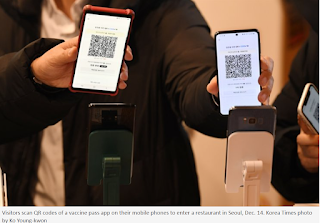
Korea's Covid vaccine pass system crashes


 On Monday of this week the Korean government initiated a vaccine pass system to limit access to restaurants, coffee shops and other establishments to those who have been fully vaccinated against COVID.  Unfortunately, as shown in the picture and widely reported in the local press, the system's servers crashed during the lunch and dinner hours due to the high traffic load.  As reported by the Korea Joongang Daily, "The country’s expanded vaccine pass system got off to a poor start Monday as it crashed around lunchtime because too many people were using it. The COOV app, which holds an official digital copy of Covid-19 vaccination records, was nonfunctional from around 11:40 a.m. to 1 p.m., preventing people from using it to gain access to facilities like restaurants and coffee shops.At around 6 p.m., the system again became very slow to load or nonfunctional.  Other apps connected to COOV for QR code verification such as Kakao, Naver and Toss Bank, also did not work, either leaving the QR Code screen blank or displaying a wrong vaccination status. "  

Sunday, October 24, 2021

Samsung World's Fifth Largest Brand Value


Samsung, by far the largest of Korea's corporations, had the fifth largest brand value in the world, according to the annual report recently published by Interbrand.  Only Apple, Amazon, Microsoft and Google had higher brand values.   This measure helps to explain why Korea is sometimes referred to as the "Republic of Samsung."  As shown in the graphic provided by Samsung's newsroom (click for a full size version) Samsung Electronics rose from 19th in the international brand value rankings in 2010 to fifth in 2020 and 2021.