- As I noted in my earlier post, something approximating net neutrality was part of South Korea's efforts to build a modern telephone network, starting in 1980. The experience here with a massive telephone service backlog and the social divisions it exacerbated made the goal of universal, equal service for all Korean citizens a non-debatable issue. From the beginning, Korea set out to build an "information welfare society" (정보복지사회) in which services and the tolls charged for them would be the same for residents of farming and fishing villages as for the residents of Seoul.
- Korea never let up on its commitment to building and improving network infrastructure. When U.S. Vice President Al Gore spoke about the importance of "information superhighways" in a 1994 speech at UCLA, the Korean government picked up on that terminology and implemented the Korea Information Infrastructure project in 1995, which gave it some of the world's most advanced fixed broadband networks in the world within a decade. Also in the 1990s Korea became the first nation in the world to commercialize CDMA for mobile telephony, giving consumers here the potential to access broadband internet while on the move.
- As readers of this blog will know, actual use of mobile data services in South Korea remained very low (around 10 percent of mobile phone subscribers) until the arrival of Apple's iPhone in late 2009 and the shock it created. Unlike the U.S. where AT&T's networks at first could not handle the data traffic generated by iPhone users, Korea had mobile networks in place with plenty of excess capacity and the big debate here in 2008 and 2009 was about how to increase consumer's use of mobile broadband services!
- Korean citizens today not only enjoy uniform rates for roughly equivalent services nationwide, but they also have developed some of the world’s highest standards for service. Most installation of telephone, broadband internet or other communication service is done on a same day basis.If problems arise with consumer electronics products, after-service (AS) is very efficient. In response to high consumer expectations for after-service, Apple has had to revise and upgrade its AS policies here.
- In short, from the vantage point of someone living in South Korea, the net neutrality debate that is so heated these days in the United States seems misdirected. If the U.S. had, like Korea, made a long term and consistent commitment to building information and communication infrastructure, along with citizen awareness of how to use these resources, the situation might be entirely different. Indeed, the general direction of ICT technology continues to be toward greater computing and communications capacity at lower costs. This basic trend, as expressed in Moore's Law, is at the heart of the information revolution. Consequently, the longer term prospect all over the world, is for an information culture in which information flows freely and abundantly, without restriction for lack of vision, commercial greed or whatever other reasons might be given.

Showing posts with label infrastructure. Show all posts
Showing posts with label infrastructure. Show all posts
Sunday, September 19, 2010
Net Neutrality: The View From Korea
More than two years ago I wrote a post for this blog on the topic of "Net Neutrality and Conceptions of Cyberspace." You'll forgive me for not following all of the twists and turns of that debate in the United States, including failed efforts by the F.C.C., court rulings and the joint statement on net neutrality by Google and Verizon. You see, living in Seoul, one might as well be on another planet when it comes to debating net neutrality. Consider the following:
Sunday, July 12, 2009
President Obama's Eloquent Reference to South Korea
"From South Korea to Singapore,history shows that countries thrive when they invest in their people and in their infrastructure; when they promote multiple export industries, develop a skilled workforce, and create space for small and medium-sized businesses that create jobs"---
U.S. President Barack Obama, Speech to the Ghanaian Parliament,Accra Ghana July 11, 2009
With the above comment in his speech to the Parliament in Accra Ghana, President Obama demonstrated that he "gets it," regarding the underlying changes needed for any country to thrive in the emerging information age. Koreans should be rightfully proud.
Monday, July 28, 2008
World Leadership in Broadband Penetration to Continue
 According to a widely-reported new study by Gartner, South Korea is likely to lead the world in broadband internet penetration for at least another five years. The nation currently has a broadband internet penetration rate of 93 percent (that means 93 percent of households here have a broadband connection to the internet), making it number one in the world. The Gartner study projects that Korea's broadband penetration will reach 97 percent by 2012. According to PC World's account of the Gartner study, the United States will have reached a broadband penetration rate of 77 percent by 2012, while the rate for The Netherlands is projected at 82 percent, Hong Kong at 81 percent and Canada at 79 percent. One of the advantages that the top three ranking countries share is that of dense populations contained in small areas. Worldwide, 17 countries will have broadband penetration rates of 60% or more by 2012, up from five countries in 2007
Saturday, May 24, 2008
Orascom Telecom Reportedly Partners to Complete Ryugyong Hotel Construction

According to Yonhap News, North Korea resumed the construction of a highrise hotel building in Pyongyang last month, which was suspended for nearly 20 years due to funding problems. The construction of the luxury Ryugyong Hotel began in 1987 with French capital and technology for completion in 1992. The 105-story building has long been left uncompleted since early 1990s amid North Korea's chronic economic problems. According to informed sources "North Korean authorities restarted the construction of Ryugyong Hotel in April." Orascom Telecom Holding of Egypt is North Korea's partner for the construction, the sources said. "If completed, the hotel will be used as an accommodation for foreign investors and visitors, a business center and an international convention center among others," a source said. The 330-meter hotel is expected to be the world's tallest when completed.
A New Boom in Undersea Cable Laying

The Economist reports, based on a Telegeography study, that there is a new boom in the laying of undersea fiber optic cable. This one is smaller than the boom that peaked in 2001 when network operators such as Global Crossing spent nearly $13.5 billion laying undersea cables (see graphic). That boom turned to bust. However, according to Alan Mauldin of TeleGeography, the current boom is much more rooted in reality. Above all, demand is now indeed growing fast, driven by video and music traffic. Between 2002 and 2007, worldwide demand for international bandwidth grew at an average rate of 52% a year. Nevertheless, today less than a quarter of the fibre-optic strands on the chief undersea routes have been “lit”, or switched on. The need for bandwidth is not the only reason for laying cable. In addition, network operators need back-up connections and alternative routes in case cables get cut, which often happens.
Wednesday, December 5, 2007
Report Positions Asia, Korea in World IT Trade
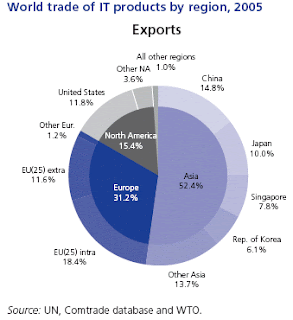
The World Trade Organization yesterday issued an important report that highlights the role of trade in the development of Korea's information economy over the past decade. The World Trade Report 2007 marks the 60th anniversary of the multilateral trading system. More importantly, it contains a section that examines trade in information technology (IT) products since the December 1996 signing of the Information Technology Agreement (ITA) by 23 economies at the first WTO Ministerial Conference in Singapore. When the ITA went into force in 1997 the trade value of the participants exceeded 90 percent of world trade in covered products. A goal of the agreement was to achieve maximum freedom of world trade in IT products by eliminating all tariffs on these products.
As noted in the report, an outstanding feature of world trade in IT products was the prominent role of Asia. In 2005 Asian economies accounted for more than 50 percent of world exports and more than 40 percent of imports of IT products. In that year, (as shown in the chart below) Korea was the world's sixth largest exporter, sending IT-related goods worth some $87.95 billion (roughly 81.13 trillion won) to other countries. The top five exporting economies were the EU, China, the U.S., Japan and Singapore. South Korea ranked seventh in the world as an importer of IT products in 2005, purchasing $59.22 billion worth of such products from other countries.
Perhaps most remarkably, South Korea was the only country other than China to maintain a continuous increase in world market share over the past nine years, despite the IT bubble bursting in the early 2000s. The entire World Trade 2007 report may be downloaded at the WTO website http://www.wto.org/


Subscribe to:
Posts (Atom)