One of my pet peeves about web sites in general and blogs in particular is that some of them don't make it easy to find out who has authored the material, what organization supports the content and so forth. To avoid that problem with this blog, I've posted a prominent link to my personal website, http://www.jamesflarson.com/ However, it occurred to me that, even on that site, it requires a couple of clicks to get to the May 2000 article in the Korean edition of Newsweek. Yet that article is probably the most interesting biographical information to explain my interests. It was published in Korean and I've also posted an English translation. Use the following links.

Friday, December 28, 2007

Sunday, December 23, 2007
Useful Links and Blogs on Korea's Information Society
With a little help from my friends I've started exploring the blogosphere to see what kind of information is being published about Korea's telecommunications development and its nascent information society. For the time being I will simply post them as "useful links" on the right-hand section of this blog, but I plan to impose a more efficient topical organization on the links as their number grows.
From my own research on The Telecommunications Revolution in Korea and my efforts to follow developments over the past decade, I've discovered that certain government ministries and their affiliated institutes here in Korea are an invaluable source of data, both Korean and English language. I've posted some of those links, including the Ministry of Information and Communication, The Korea Information Society Development Institute, and the National Information Society Agency. There are more links to come in this category and not all are affiliated only with the Ministry of Information and Communication.
Among international organizations, the International Telecommunications Union and the Organization for Economic Cooperation and Development are must visits for anyone with a serious interest in following developments here in Korea.
Blogs on the topic promise to be another very helpful source of information for understanding what is going on in South Korea as it constructs broadband convergence networks that are intended to lead to a ubiquitous Korea and a version here on the peninsula and globally of Web2.0.
Friday, December 21, 2007
Forthcoming Seoul Conference on "The Future of the Internet Economy
 The OECD will host a Ministerial Meeting on "The Future of the Internet Economy" 17-18 June 2008 in Seoul. It will examine the implications of the rapid growth in the use of the Internet for our economies and societies and the policies needed for continued growth.
 For additional information on the conference, consult the OECD website
©Picture: David Rooney
Saturday, December 15, 2007
VOIP services--global growth

The graphic depicts a worldwide trend toward greater use of the internet (VOIP services) to carry voice telephony. Since Korea is arguably the most networked (wired and wireless) country in the world, it will be of particular interest to see how quickly VOIP services penetrate the market. The growth of VOIP, along with internet television (IPTV), is part of the general phenomenon of convergence that will lead to ubiquitous availability of information.
Language and Cyberspace
A striking aspect of internet usage in Korea is that the vast majority of Koreans prefer to surf the web in their own language, 한국말. While you might think that this should come as no surprise, the strong preference for Korean is often overlooked by companies or organizations seeking to do business or conduct affairs in Korea. Some of them mistakenly assume that the near-universal passion for learning English in Korea means that people here will gravitate to English-language materials on the web. The available empirical evidence points instead to a strong preference for Korean language on the web. Data from the early 1990s to the present shows that the number of internet users in South Korea did not significantly increase until there was an increase in the number of .kr domain names on the web. The web site of the National Internet Development Agency is the best official source of such data, and it has an English-Korean toggle. http://isis.nida.or.kr/eng/ The continued dominance of NAVER as the internet search engine most frequently used by South Koreans has a lot to do with the fact that it is a Korean-language engine that returns largely Korean-language results. While on the subject of language, I suggest that Koreans who want to read my posts in Korean use Google Language tools. While this automated translation service is far from perfect, I think it is the best currently available. The steps are easy.
- Go to the language tools site http://www.google.com/language_tools
- Scroll down to "Translate a Web Page" and enter http://koreainformationsociety.blogspot.com/ Then on the scroll-down menu, set your preference to translate "English to Korean."
- Click on the "Translate" button and you will quickly have a rough translation of this site into Korean.
Look to this blog for further musings about the role of language in creating the boundaries of cyberspace.
"I Am Robot"
I just finished watching the last fifteen minutes or so of a television program called "I Am Robot," on YTN. The program itself was produced by a science TV channel. The segment I watched featured a robot festival at a large exhibition hall somewhere in Korea. Students from several universities entered their robots in a variety of competitions, including relay races, basketball, dancing, music and so forth. Some of the robots could mimic human moves, if one of the students wore a specially designed electronic suit. Others were controlled from a small hand-held panel.
A few things impressed me about this robot festival.
- One was the obvious enthusiasm of the college students for their projects.
- Another was how human-like some of the movements by the robots were. These were all humanoid robots, with two arms, two legs, and most of the major joints that a human being has.
- The audience for the robot competitions included quite a number of grade-school children and their enjoyment of the festival could be seen on their faces. Might this competition influence some of them to pursue a career in mechanical engineering and make a future contribution to robotics?
Korea is investing a great deal these days to develop the field of robotics. See, for example, the activities of the Intelligent Robotics Laboratory (지능로봇 연구실) in the Department of Mechanical Engineering at Korea University. http://robotics.korea.ac.kr/index.html?lang=eng Most of the other top universities have similar efforts underway, not to mention the work of government research institutes. Robots promise to play an interesting role in Korea's future information society as networks become ubiquitous.
Wednesday, December 5, 2007
Report Positions Asia, Korea in World IT Trade
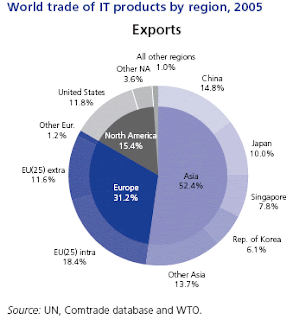
The World Trade Organization yesterday issued an important report that highlights the role of trade in the development of Korea's information economy over the past decade. The World Trade Report 2007 marks the 60th anniversary of the multilateral trading system. More importantly, it contains a section that examines trade in information technology (IT) products since the December 1996 signing of the Information Technology Agreement (ITA) by 23 economies at the first WTO Ministerial Conference in Singapore. When the ITA went into force in 1997 the trade value of the participants exceeded 90 percent of world trade in covered products. A goal of the agreement was to achieve maximum freedom of world trade in IT products by eliminating all tariffs on these products.
As noted in the report, an outstanding feature of world trade in IT products was the prominent role of Asia. In 2005 Asian economies accounted for more than 50 percent of world exports and more than 40 percent of imports of IT products. In that year, (as shown in the chart below) Korea was the world's sixth largest exporter, sending IT-related goods worth some $87.95 billion (roughly 81.13 trillion won) to other countries. The top five exporting economies were the EU, China, the U.S., Japan and Singapore. South Korea ranked seventh in the world as an importer of IT products in 2005, purchasing $59.22 billion worth of such products from other countries.
Perhaps most remarkably, South Korea was the only country other than China to maintain a continuous increase in world market share over the past nine years, despite the IT bubble bursting in the early 2000s. The entire World Trade 2007 report may be downloaded at the WTO website http://www.wto.org/


Tuesday, December 4, 2007
Some Historical Perspective--the 1980s
Many observers of South Korea's telecommunications networks and technology today fail to grasp the historical antecedents that led to this situation. To do so, it is necessary to recall the 1970s, when lack of basic telephone service was one of the major social problems in the country. Then, during the period from 1980 to 1987, the government and industry implemented a long-term plan to revitalize the electronics industry. In three critical areas, this plan laid the foundation for the South Korean economy that we observe today.
First, in a highly controversial move, the government decided to implement color television broadcasting and to encourage the manufacture of color television sets. By 1980, more than 100 other countries in the world were already broadcasting in color, but former President Park Chung Hee had opposed its introduction in Korea. The electronics sector suffered because Korean companies that manufactured black-and-white television sets were simply manufacturing the boxes and importing all of the components. Contrast that situation to today when Korean companies lead the world in exports of flat panel color displays and television sets.
Second, South Korea decided that it needed to develop the capacity to manufacture semiconductors, the raw materials with which many of today's electronic devices are built. This project succeeded and the nation now leads the world in manufacture of DRAM memory chips, certain categories of flash memory and is a major player in semiconductors.
Third, Korea focused on developing the ability to manufacture its own switching systems. The success of the TDX project meant that the nation would be able to manufacture these critical components of telecommunications networks and thereby not only solve its desperate backlog in telephone subscriptions, but also modernize its network and export network technologies around the world.
Without its major successes in these three areas, there is no way to imagine the highly networked information environment that exists in South Korea today.
Subscribe to:
Posts (Atom)